
Disclaimer: This Inside South Florida segment is sponsored by Speedy Piper Underground. All opinions and views are of the advertiser and does not reflect the same of WSFL-TV.
When a home needs sewer line repairs, homeowners have options, and according to Wesley Da Silva, manager at Speedy Piper Underground, tunneling is the one that keeps a home's structure fully protected.
What is tunneling?
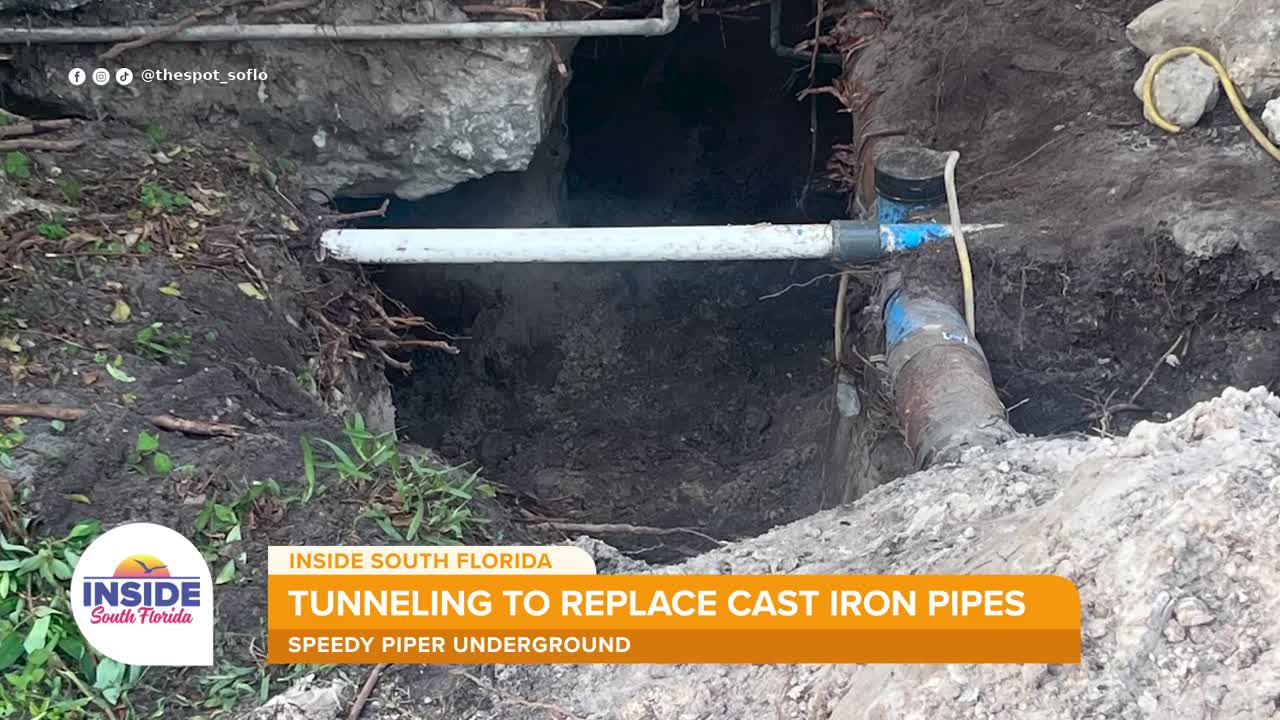
Tunneling is the process used to gain access to the sewer lines beneath a home. All tunnels are dug at a uniform size of 3 feet by 3 feet, with the length varying depending on the size of the home.
Da Silva explained the process step by step.
"We set next to the outer wall of the house. And then we dig first four feet down to go around the footer of the house. And then from there we get access to the main line that goes out to the city. And then we follow that pipe and we start digging next to the pipe. We leave the pipe actually on to the dirt, and we dig next to it," Da Silva said.
Soil type matters
Knowing what lies beneath a home before digging begins is a critical part of the process. Speedy Piper Underground has the soil composition of Miami-Dade County mapped out, allowing crews to know in advance whether they are digging through sand or coral rock.
In Broward County, most of the soil is sand, with the exception of areas like Coral Springs, Margate, and parts of Hollywood, which sit on solid coral rock. Miami-Dade County is largely the opposite; most of it is coral rock.
"It's a different type of method that we're going to be digging here. We dig everything with a shovel and a pickaxe, and down there is all chipping hammers, but still the same machine sucking out the dirt or the rock and still able to do it," Da Silva said.
Tunneling vs. traditional cutting
The key advantage of tunneling over traditional cutting methods comes down to structural integrity. Da Silva described it this way: a home is built as one solid unit, concrete, bricks, and all. Traditional cutting breaks that unit apart.
"If you do the traditional method of cutting no longer solid. What did you do? You cut so that the structure is no longer one. You had to patch it up, but still you had to put a patch on something that was one," Da Silva said.
Tunneling avoids that problem entirely.
"When we tunnel under, that structure stays intact; we don't touch it. We tunnel under everything. So there's nothing that affects the structure at all," Da Silva said.
For more information, visit speedypiperunderground.com or reach out through their Instagram page.
This story was reported on-air by a journalist and has been converted to this platform with the assistance of AI. Our editorial team verifies all reporting on all platforms for fairness and accuracy.