
Disclaimer: This Inside South Florida segment is sponsored by Ossio. All opinions and views are of the advertiser and does not reflect the same of WSFL-TV.
Dr. Brian Cole, sports medicine expert and professor of Orthopedics at Rush University Medical Center, is highlighting a minimally invasive knee procedure designed to treat bone pain in patients with cartilage disease.
The procedure, called KneeBar®, addresses what researchers have identified as a key source of pain, the bone itself, in patients who present with cartilage disease.
"As a sports medicine specialist, my emphasis as a professor at Rush University Medical Center has been on sports medicine, typically shoulder, elbow, knee issues, has been on joint preservation. And joint preservation is a subspecialty where we emphasize cartilage repair and cartilage replacement. What we have identified is the fact that the bone itself may be responsible for the pain in patients who present to us with cartilage disease," the Cole said.
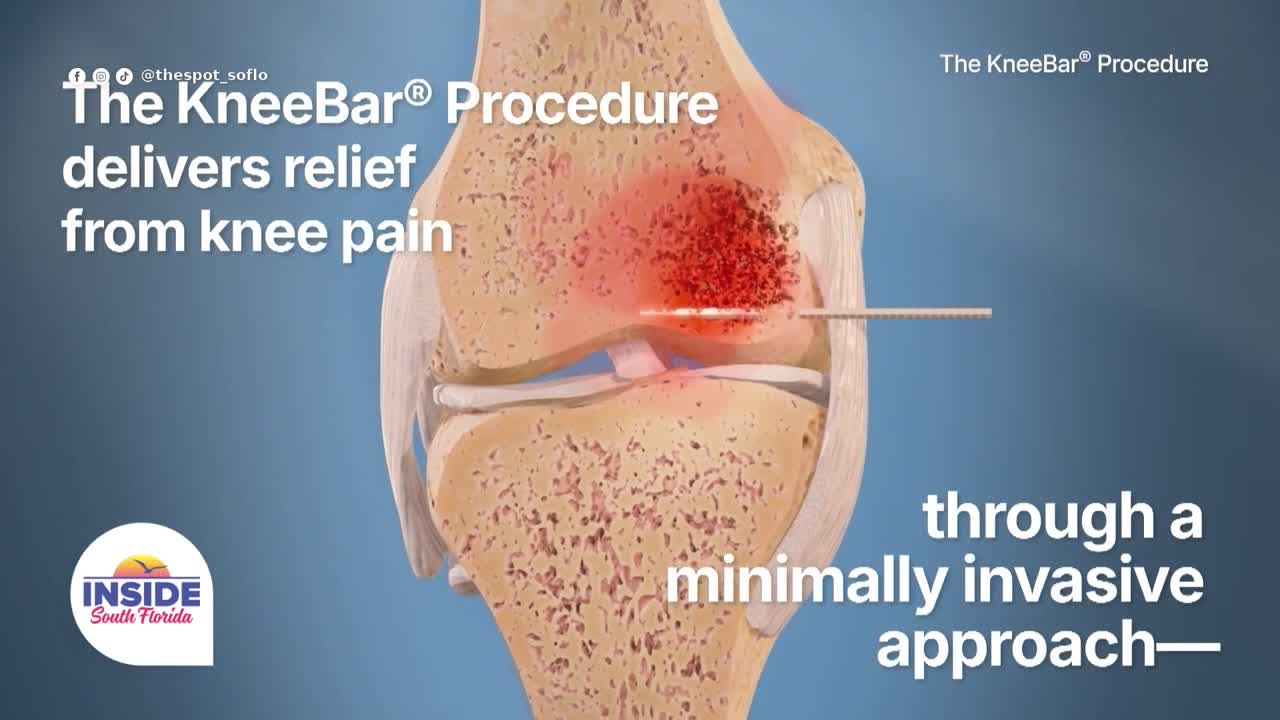
The KneeBar® procedure uses a device placed through the bone just below the cartilage surface, where cartilage has begun to fail. The goal is to share load, provide structural support, and integrate with healthy bone over time.
"The bar procedure is a procedure that is designed to treat the bone problem that I just discussed. So it's a minimally invasive procedure that uses a device that's placed through the bone just below the cartilage surface, where the cartilage has just started to fail in an effort to share load, provide structural support, and also get biointegrated over time by healthy bone," the Cole said.
The procedure was introduced more than 3 years ago. More than 1,200 patients have undergone the KneeBar® procedure. Researchers first studied it in a pilot study for safety, and a subsequent multicenter study showed efficacy with reductions in pain and improvements in function.
"We've followed them outwards of two years looking at their patient-reported outcomes as they have actually tracked, with improvements in their MRI findings and their structural findings," Cole said.
Two patient groups are considered especially good candidates for the procedure. The first is patients with a specific type of meniscus tear called a meniscal root tear, where the meniscus is torn away from the bone, resulting in sudden loss of meniscus function and bone pain. The second group includes patients with minimal to moderate arthritis, but not bone-on-bone arthritis, who also show structural findings on MRI.
Rehabilitation following the procedure varies by patient. Those who undergo a meniscus repair are protected on crutches for the first 4 to 6 weeks, then resume activities as tolerated.
Patients can visit kneebardoc.com to find surgeons in their area experienced with the KneeBar® procedure.
This story was reported on-air by a journalist and has been converted to this platform with the assistance of AI. Our editorial team verifies all reporting on all platforms for fairness and accuracy.