
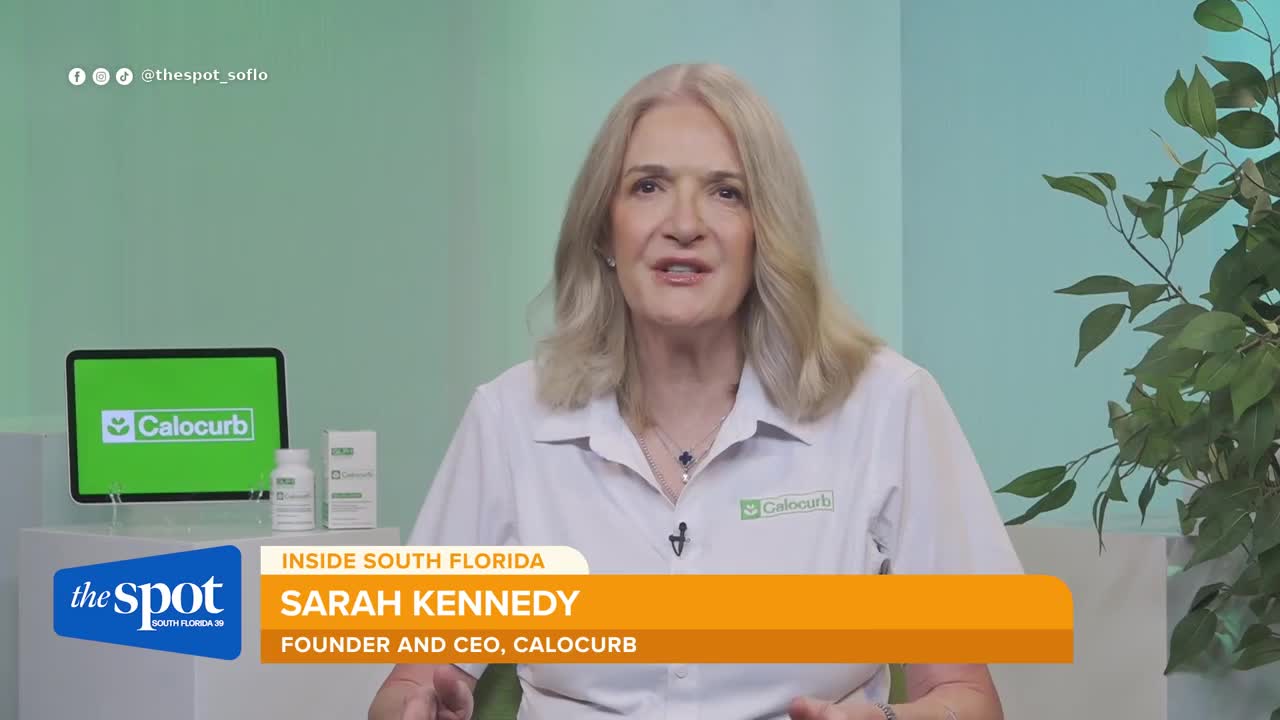
Disclaimer: This Inside South Florida segment is sponsored by Calocurb. All opinions and views are of the advertiser and does not reflect the same of WSFL-TV.
A new clinical study is adding fuel to a growing conversation about
GLP-1 medications and muscle loss, and pointing to a natural alternative
that may work differently.
GLP-1 medications have become one of the most talked-about
weight loss solutions in recent years, but a growing concern is that
people may be losing muscle along with fat.
New clinical research is now pointing to a natural alternative that changes the conversation entirely.
The study was published in Obesity Pillars and was conducted on
150 patients, men and women with a BMI between 25 and 35, over six months.
Sarah Kennedy, founder and CEO of Calocurb, said the results stood out because of what kind of weight participants lost.
"We are so excited about this new clinical study. It was published ten days ago in Obesity Pillars, and it was done on 150 patients, men and women with a BMI between 25 and 35 over six months."
Kennedy said the findings highlight a key difference between Calocurb and synthetic GLP-1 medications.
"What it showed in the treatment group was that they lost a significant
amount of weight, but it was all fat. Now, this is where the difference is.
The fact that often, with GLP-1 medications, you can lose up to 40%
of muscle mass. So that's within your weight loss. So the conversation is
now changing from looking at the scales to looking at body composition."
Calocurb works by stimulating the body's own natural appetite-suppressing hormones, including GLP-1, Kennedy said.
"We work by stimulating your own natural appetite-suppressing
hormones. One, of course, which is GLP-1.
So we super stimulate those and we kind of we hack your hunger.
So you take it an hour to an hour and a half before a main meal
and you will just you will eat less. You'll eat on average 18 to 20% less."
Kennedy said the distinction between Calocurb and synthetic
GLP-1 medications comes down to how each interacts with the body.
"The synthetic hormone listening to theta hormone. You're actually
having a synthetic hormone that you're either injecting or taking orally.
So it is a mimic of your natural hormone your natural GLP one. But what
they've done is changed a tiny molecule in it. So it lasts for seven days. So you've got high levels of GLP one for seven days.
Calico works by stimulating that natural those natural hormones, one of which is GLP -1, and it lasts for 4 to 6 hours. So we work with your body tohelp you manage your food and manage those portion control."
Calocurb is backed by 16 years and $30 million in research conducted by
the New Zealand government.
More information, including the science behind the product and its development, is available at Calocurb.com.
First-time customers can use the discount code START for 10% off their first order.
This story was reported on-air by a journalist and has been converted to this platform with the assistance of AI. Our editorial team verifies all reporting on all platforms for fairness and accuracy.