
Disclaimer: This Inside South Florida segment is sponsored by Your Bucket List Guide. All opinions and views are of the advertiser and does not reflect the same of WSFL-TV.
With over 80% of the world and 99% of people in the U.S. and Europe living under light-polluted skies, astro tourism has become one of the hottest travel trends of the year. And Australia's Northern Territory is now at the center of it.
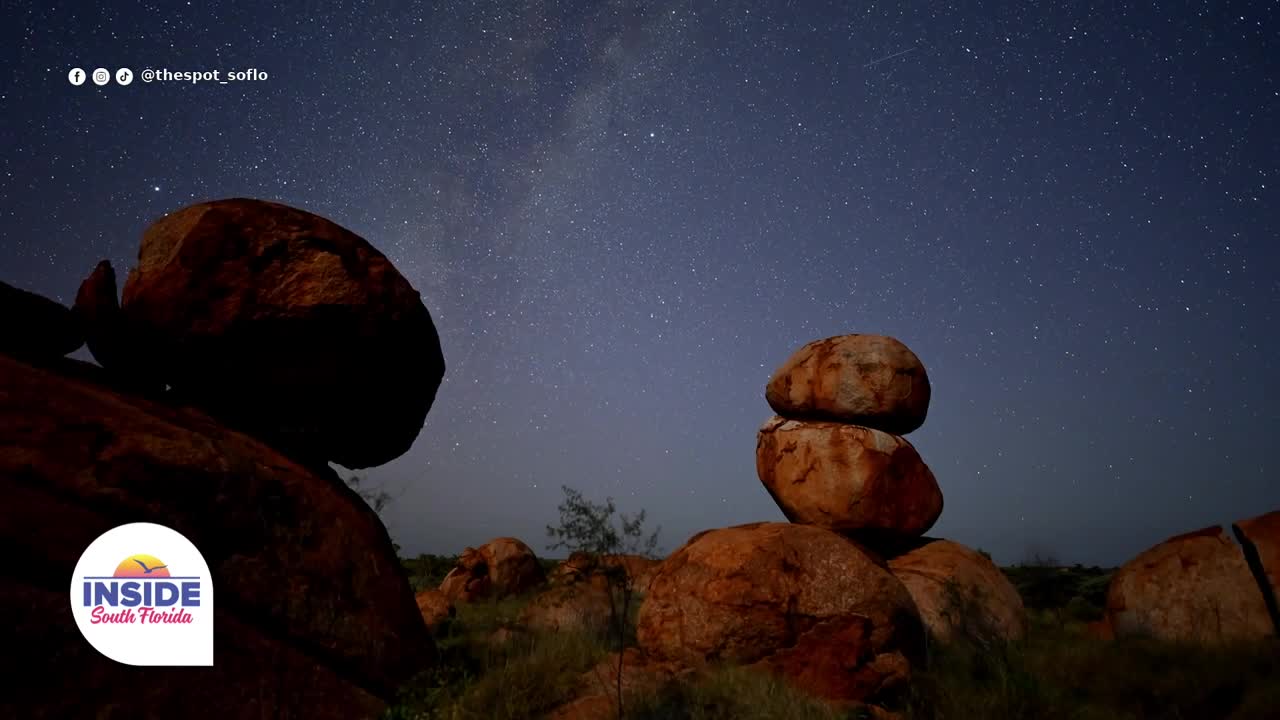
Iconic Kalu Kalu, also known as Devil's Marbles, was just named an international dark sky sanctuary, a designation that functions like a national park for the night sky. These sanctuaries are legally protected areas of true, untouched darkness, where city lights cannot wash out the stars.
"When you step outside, you're not just seeing a few stars; you're seeing millions of stars in the Milky Way popping for your naked eye," travel expert Justin Walter said.
Walter, who visited the Australian outback at age 21, described the experience as life-changing.
"Lying under those stars, it was like someone threw glitter into the sky," Walter said. "It changed my life. It made me want to dedicate my life to travel because it was so powerful and beautiful."
The Northern Territory's connection to the stars runs far deeper than the current astro tourism trend. Aboriginal people have been observing and sharing stories about the night sky for 60,000 years, the oldest continuous traditions in human history. Around campfires, Aboriginal elders would point to constellations, share stories, teach navigation, and pass down living history.
Today, travelers can visit Uluru, Australia's spiritual center, and take part in after-dark experiences that bring those traditions to life. Options include intimate, open-air fine dining on private desert dunes, where local storytellers share culture alongside guided stargazing talks. There is also a drone show featuring hundreds of drones and laser lights that illustrate cultural stories in the night sky.
"The Northern Territory is offering something that is getting harder and harder to find," Walter said. "It's a rare sense of silence, open spaces to reset and to slow down, and limited light pollution and just beautiful night skies everywhere."
Astronomy Day is Saturday, September 19. Travelers interested in planning a dark sky adventure in Australia's Northern Territory can visit northernterritory.com. Additional travel inspiration is available at yourbucketlistguide.com and at @yourbucketlistguide on social media.
This story was reported on-air by a journalist and has been converted to this platform with the assistance of AI. Our editorial team verifies all reporting on all platforms for fairness and accuracy.